Start with one cabinet
Empty one cabinet onto a clear surface. Group its contents by use: everyday meals, food preparation, leftovers and occasional entertaining. Match food containers with their lids before deciding how much space they need. Set aside items that belong elsewhere rather than walking around the apartment after every object. Keep shared household belongings out of rushed donation decisions. Wipe the cabinet and let it dry before returning anything. If there are too many items to restore comfortably, reduce the scope of your session instead of leaving the kitchen covered in piles.
Measure the opening and the shelf
Record usable width, depth and height. Check the opening between hinges and behind any center frame. A bin can fit on the shelf but fail to pass through the door. Open nearby drawers to see whether they would block a pull-out container. For a shelf insert, check the space both beneath it and above it. You need room to grasp a mug or lift a plate, not merely enough height for it to sit. Follow the cabinet and organizer load limits rather than assuming an extra shelf increases the weight the cabinet can support.
Use the measuring guide to check openings and clearance before choosing an organizer.
Put everyday dishes within easy reach
Give frequently used dishes a comfortable, reachable position. Keep heavy cookware low enough to handle safely and lightweight occasional items in less convenient spaces. Separate everyday plates from a large serving platter if removing a plate currently means lifting the whole pile. Several modest stacks may work better than one tall stack. Where a shelf is adjustable, reposition it only as the cabinet design permits and check that all supports are correctly seated.
Keep lids identifiable
Try standing suitable lids upright in a stable container you already own. Group them by shape or size, with the ones used most often at the front. Fragile lids need storage that supports them securely. Nest food containers only when they separate easily, and keep matching lids nearby. Resolve missing-lid problems before buying a bigger organizer. A larger box does not make mismatched pieces useful.
Use vertical storage selectively
A suitable divider can hold baking sheets or cutting boards where there is enough height and depth. Test the largest item first. The divider must remain stable when an item is removed; a tight gap between heavy pans is not a substitute for proper support. Follow cookware care instructions when stacking, especially for coated surfaces. Keep handles clear of hinges. If removing one pan means lifting several heavy pieces, change the arrangement before adding another rack.
Try a two-shelf layout
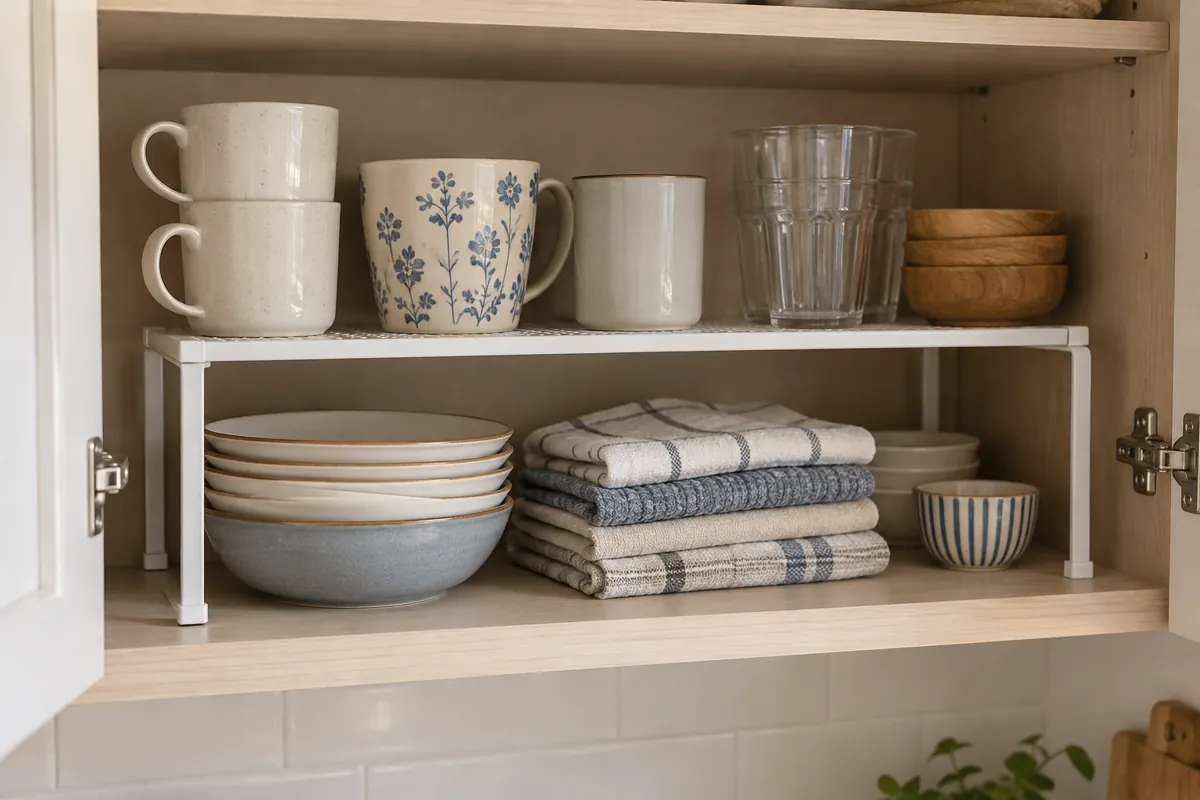
For a cabinet holding plates, mugs and leftover containers, start with plates and mugs on the most convenient shelf. Group matched containers on the other shelf and use one small container for suitable lids. Move an occasional platter elsewhere if it crowds the everyday dishes. Use this arrangement during normal meals before purchasing anything. If the remaining problem is unused height above mugs, measure that specific gap. If the problem is unused mugs, another shelf will not solve it.
Buy for one remaining problem
Write a sentence describing what still goes wrong: “I cannot reach the lids without removing every container.” Compare any organizer with that job, the available dimensions and its intended use. Check cleaning needs, total cost and return conditions. Use appropriate food-safe containers for direct food storage. Reused cardboard is only a possible divider for non-food objects in a dry space. Keep packaging information needed for safe use. Begin with one cabinet. Keep the layout that makes daily routines easier, even if the containers do not match.
Product options to compare
Affiliate disclosure: As an Amazon Associate I earn from qualifying purchases. Purchases through these links may earn us a commission at no additional cost to you. Read our affiliate disclosure.
These options were selected from product listings, not hands-on testing. Measure your space and confirm the current variant, dimensions, price and return terms on Amazon. The editorial images above do not depict these specific products.