Define what it needs to hold
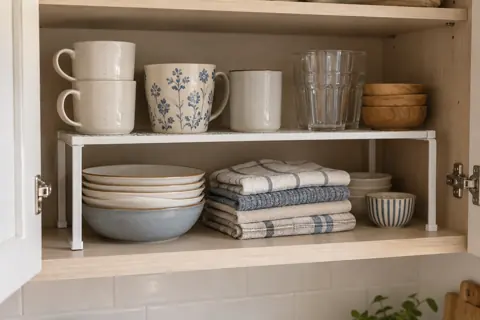
Gather the intended contents and measure the largest relevant item. Consider how you will remove it. Folded towels, tall bottles and papers require different access. Write a short job description, such as “hold four folded hand towels on the shelf.” Try a container you already own before choosing another. Filling an empty gap is not a useful job by itself.
Measure the narrowest opening
Measure the route into the space, including frames, hinges and drawer openings. Record the limiting width rather than the widest part of the interior. Do not assume diagonal insertion will work once a container is full. Test with a suitable empty mock-up if needed. An organizer should be removable without forcing it past hinges or damaging furniture.
Record usable width, depth and height
Measure at more than one point where obstructions or uneven surfaces matter. Account for pipes, supports and hardware. Write units beside every measurement and use the same units when comparing a listing. Keep a record of opening width, usable width, usable depth, usable height and obstructions. A photograph can help you remember the layout, but it does not replace measurements. Avoid a fit so tight that small variations prevent use.
Compare inside and outside measurements
Outside dimensions determine whether the organizer fits its location. Inside dimensions determine whether the contents fit the organizer. Tapered sides, rounded corners, thick walls and lids reduce usable capacity. Read the manufacturer's diagram. Check whether handles and rims are included and whether dimensions are listed as width, depth or length in a different order. If a critical measurement is missing, seek clarification rather than guessing.
Allow for movement
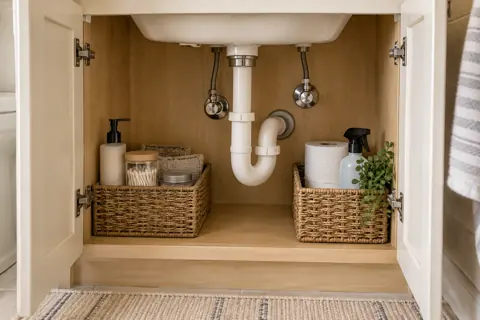
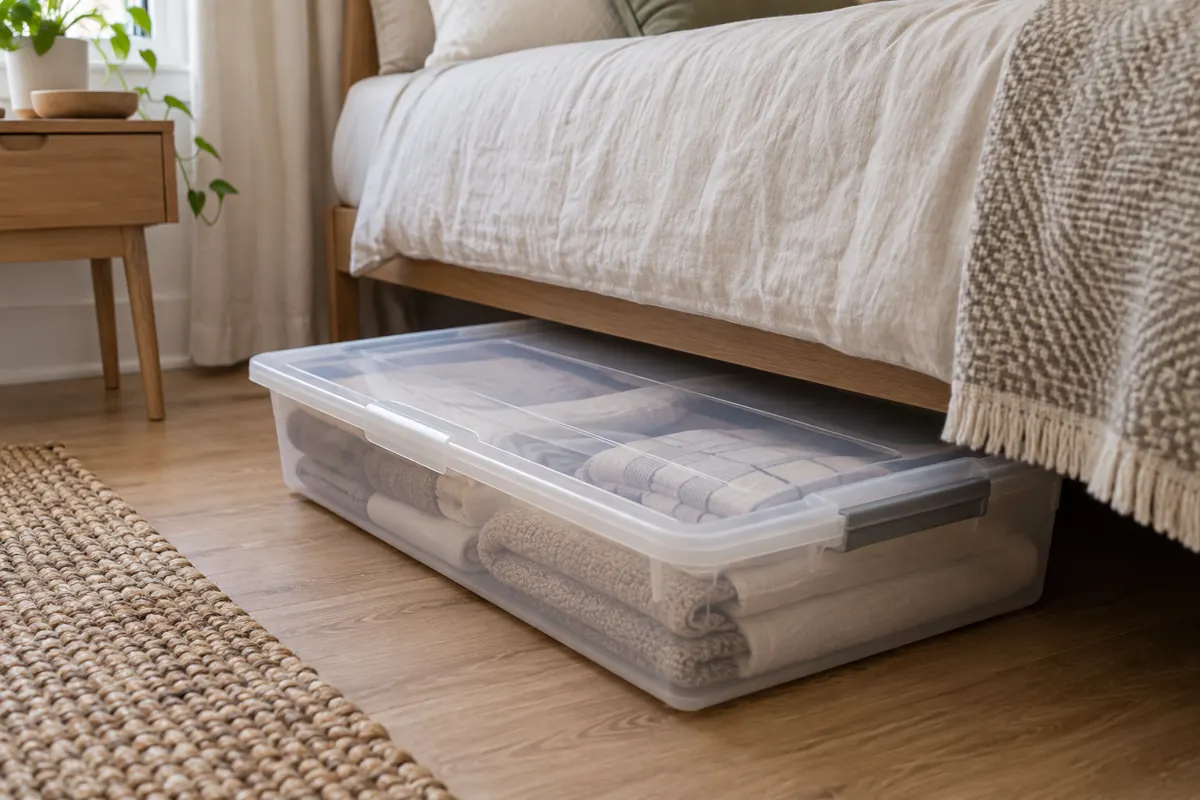
Check how far a bin must slide out and whether you can grasp its handle. Leave enough room to open or remove a lid and lift the contents. For a shelf insert, check access both above and below it. Under a bed, measure the lowest obstruction along the whole route, not just the open edge. Around plumbing, keep valves and connections accessible. Fitting while everything is closed is only half the test.
A worked example
Imagine a shelf with 24 inches of usable width and 14 inches of depth, but an opening only 22 inches wide between hinges. Two bins each 11.5 inches wide total 23 inches and appear to fit the shelf. A fixed combined unit of that width would not pass straight through the opening. Separate bins might enter one at a time, but their rims, handles and removal paths still need checking. A bin advertised as 13.5 inches deep could also be too deep if that figure excludes its handle. These are illustrative measurements, not recommended dimensions for your cabinet.
Test the footprint
Use an existing box or a simple cardboard mock-up for a dry, supervised space check. Match the proposed external dimensions and mark projecting handles or an open lid. Try the removal movement you would make every day. A cardboard model checks fit, not strength. It does not prove shelf load capacity or suitability near moisture or heat. Confirm intended use, weight limits and installation requirements separately.
A final purchase check
Ask: will it enter the space? Will the full external dimensions fit? Are the inside dimensions large enough? Can I open, grasp and remove it? Will doors close? Are access points and required clearances preserved? Can I follow the installation instructions? Finally, check quantity, total delivered cost and return conditions. Keep the measurement note to compare alternatives. If a critical dimension is unknown, pause the purchase. A few careful measurements are more useful than another organizer that almost fits.